Summary
Cataloom is a self-built catalogue tool for the Microsoft data stack that runs read-only against SQL Server or Azure SQL and produces three layers: AI-generated documentation with an interactive lineage graph, a deterministic audit (dead objects, orphaned foreign keys, collation conflicts, non-deterministic UPDATE...FROM) and a compact llms.txt-style context format for your warehouse. All output is self-contained HTML without external requests; the AI steps run optionally against the user's own Azure OpenAI resource, so schema and procedure logic does not leave the tenant. Relations and lineage are mined deterministically from the actual view and procedure code, not invented by a language model.
The brief
Existing catalogue tools dump the schema structure and leave the descriptions for a person to type; Microsoft Purview serves the same need, but is heavy and enterprise-grade. Cataloom lets the AI read the procedure and view logic itself and write the business description, while relation and lineage knowledge comes deterministically out of the code, so the AI invents no evidence.
What I built
- A read-only connector (SQL auth or Entra token) against SQL Server and Azure SQL
- Catalogue introspection: objects, columns, keys, foreign keys, triggers, dependencies and index usage
- An AI description engine that turns procedure and view definitions into business descriptions, with a bring-your-own Azure OpenAI key
- Deterministic relation mining: declared foreign keys plus join mining from the view and procedure code
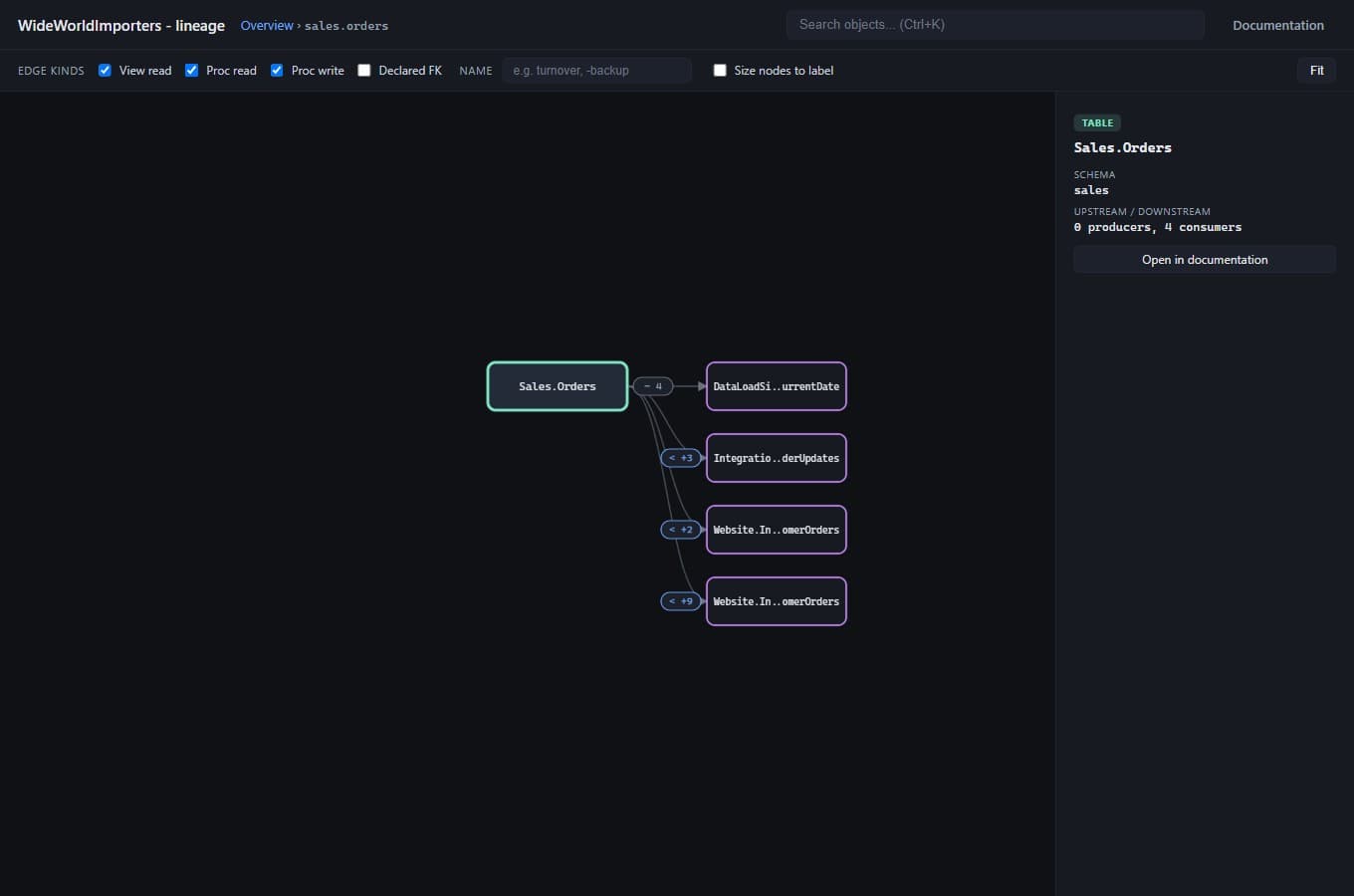
- An object lineage graph with a layout implementation of its own, as an interactive self-contained HTML viewer with search and focus
- An audit check registry with deterministic checks, a snapshot diff between runs, and live read-only confirmation of uncertain candidates
In detail
- AI documentation with lineage: searchable, self-contained HTML with one fact sentence per object and an interactive lineage graph
- Deterministic audit: checks on dead indexes, orphaned references, collation conflicts, disabled triggers and non-deterministic UPDATE...FROM, with a summarising AI verdict
- AI context (llms.txt for your warehouse): a compact, deterministic fact-sentence format with a confidence filter, to give an LLM session knowledge of the warehouse
- Privacy by design: db_datareader rights are enough, a bring-your-own Azure OpenAI key, and no step leaves the tenant
- Positioned as a light wedge against Dataedo, Redgate SQL Doc, SchemaSpy and Microsoft Purview
Outcome
Live since August 2026 at cataloom.io: a Dutch-first product site with a click-through demo of the actual report, run against the public WideWorldImporters sample database, and a free audit on one database as the entry point. The functionality is verified end to end against a production data warehouse on Azure SQL and covered by a pytest suite; market validation (a demand test, willingness to pay) is the current step.